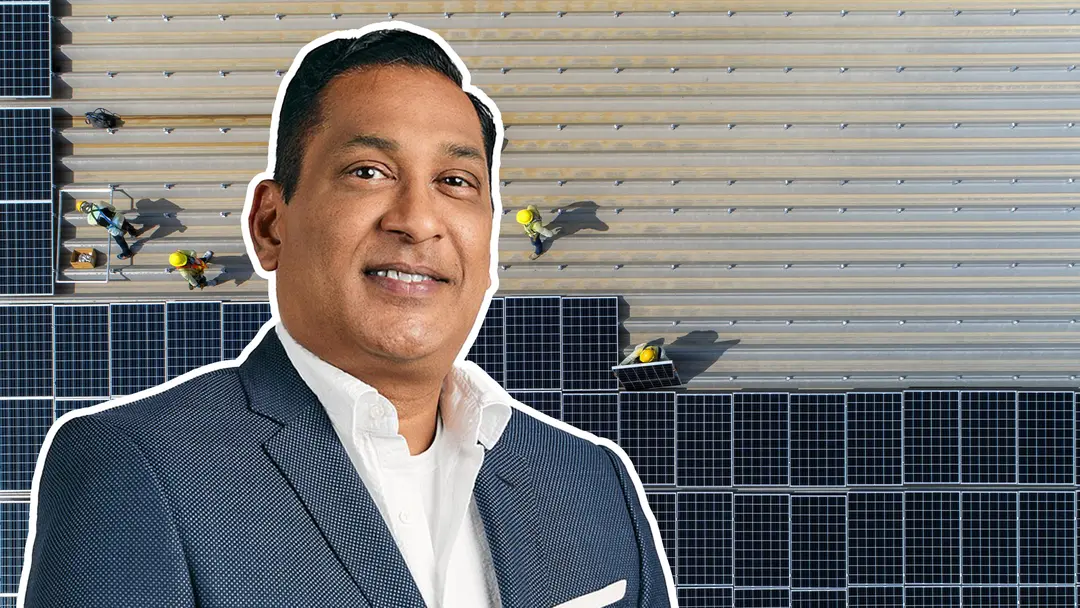
OnePlanet CEO André Pujadas on building solar recycling infrastructure in the US
Solar deployment in the United States has scaled rapidly. Recycling infrastructure has not.
André Pujadas, CEO and co-founder of OnePlanet Solar Recycling, argues that the gap between installation and end-of-life recovery isn’t just an environmental oversight; it’s an industrial arbitrage opportunity.
A trained engineer with a three-decade career spanning steelmaking, procurement, and metals recovery, Pujadas previously held senior roles at Nucor Corporation, Severstal International, and PSC Metals. His experience in electric arc furnace (EAF) steelmaking, where scrap became the foundation of a domestic manufacturing revolution, shaped his view of solar waste not as disposal, but as feedstock.
In this interview with Interesting Engineering (IE), he explains why solar recycling should be treated as manufacturing infrastructure, and why the US must build it quickly.
Interesting Engineering: Looking back, how did your journey begin?
André Pujadas: My background has always revolved around heavy industry. But Nucor’s story shaped how I think and approach the solar industry. They built the largest steel company in America not by mining iron ore, but by melting scrap metal in electric arc furnaces.
The mini-mill revolution didn’t just change steelmaking. This demand for recycled iron units created and incentivized an entire domestic infrastructure for collecting and processing scrap metal at industrial scale.
The disconnect became obvious – the solar industry created a materials arbitrage without realizing it. Deployment scaled faster than anyone projected, but no one built the back-end infrastructure to recover value at end-of-life. OnePlanet was founded to capture that arbitrage.
IE: You’ve worked across raw materials sourcing, steel making and advanced process technologies. What first drew you into that world?
I am an engineer by training, it was the complexity of steelmaking that drew me in. You optimize multiple variables simultaneously: raw material quality, energy consumption, throughput, yield and product specifications.
Every decision cascades through the system. I liked that the problems could be challenging and felt motivated that the results were measurable. And there’s no hiding from the results. For someone with an engineering mindset, it’s the ideal environment.
Engineering school teaches you to think in systems, steelmaking teaches you to operate them under pressure. Later, when I moved into commercial roles, I saw the same complexity from a different angle. The operational and commercial sides of the business are deeply connected.

IE: After your experience in steel, what misconceptions do you still see around industrial-scale recycling?
There are two misconceptions I have encountered. The first is that industrial-scale recycling is essentially waste management, just cleaner and more responsible. But that framing misses the point entirely. At scale, recycling is manufacturing.
The second misconception is that recycling is inherently profitable because the environmental case is so clear. Recycling only works when three elements align. These are consistent feedstock supply, processing technology that achieves target recovery rates at competitive cost, and downstream buyers who value the output enough to pay for it.
IE: You held senior positions at Nucor and Severstal. What elements of their innovation culture are you trying to replicate at OnePlanet?
These companies had a progressive culture – decentralized and lean, with quick decision making and intensely focused on performance that rewarded employees. A few elements have always stood out and resonated with me, that I have seen work at its best and try to replicate at OnePlanet.
These were operator-driven innovation, relentless incremental improvement, speed with minimal bureaucracy, radical transparency, egalitarian leadership, disciplined risk-taking on new technology, learning from failure, and tightly aligned incentives.
IE: What convinced you to leave steel and move into solar panel recycling?
The solar industry has spent two decades focused on deployment and becoming the low carbon clean renewable energy of choice, getting panels installed on rooftops and into utility-scale farms. But nobody was asking, or willing to think about, what happens to these assets in 15 to 20 years.
Now, we are faced with the surging wave of end-of-life panels. Today, 10 million solar panels reach end-of-life annually. As repowering and decommissioning of earlier assets accelerates, volumes are expected to increase to an average of 70 million panels annually from 2031 to 2040. By 2050 this escalating waste stream is forecasted to be up to 10 million tons in the US alone.

IE: What made you realize the PV industry needed a company like OnePlanet?
The lag between solar deployment and recycling readiness for utility asset owners is the bridge OnePlanet is building. Our current trajectory is to scale these metal recovery facilities in different geographies of the US, particularly areas of concentrated solar installations.
Successful deployment of PV recycling plants triggers cascading benefits across the entire system, like strengthening domestic supply chains for critical materials.
IE: How did you validate that solar recycling could scale industrially, not just technologically?
Technology validation happens in the laboratory. Industrial validation outside it. Our Florida pilot plant gave us exactly that, because we learned what works at throughput, not just in theory or experiments.
Those empirical data points were implemented into RiverCity‘s final engineering design, our first industrial scale recycling plant with a rated capacity of six million modules per year. In addition, the pilot validated unit economics under varying commodity prices, supply volumes, and gate fee scenarios.
In parallel, we conducted a comprehensive Total Addressable Market analysis to map regional waste streams, logistics realities, and infrastructure needs across the US. Federal validation came through USD 14.5 million in Section 48C tax credits, and our R2v3 Appendix G certification confirms we can operate at industrial scale with auditable traceability.
For us, the question was never whether solar recycling would scale – it was how quickly we could build the infrastructure to lead it.
IE: Are solar panels challenging to recycle compared to other industrial waste streams?
They’re challenging in different ways. Solar panels are composite materials. They are tempered glass, EVA, silicon cells, aluminum frames, copper wiring, as well as silver contacts, all laminated together and designed not to come apart and last for 20-25 years. The glass in a panel represents 75-76 percent of the mass but only a fraction of the value.
The challenge isn’t separating the materials, rather doing so economically while maintaining purity for commodity markets. Our proprietary technology achieves more than 99 percent material recovery rates without the energy intensity and environmental, safety and hygiene risks of thermal and chemical processes.
IE: Why is solar recycling not only necessary but also economically viable?
Solar waste is guaranteed, concentrated and grows exponentially. There is circa 266 gigawatts (GW) of installed solar capacity in the US. That represents nearly half a billion panels. Current installed PV recycling capacity is disproportionally low compared to the anticipated demand over the next decade.
Solar PV accounts for 77 to 99 percent of global polysilicon consumption, with crystalline silicon technology representing over 90 percent of the PV module market. This makes PV recycling a potentially significant source of recovered polysilicon as panels reach end-of-life.
By 2030, the solar industry is expected to be the fastest-growing source of silver demand, reaching 10,000 – 14,000 tons per year. Silver cannot be mined more as it’s primarily a by-product of other mining. Recycling end-of-life panels becomes a critical supply pathway.
IE: How do you see the US positioning itself against China’s dominance in PV manufacturing?
China dominates the front end of the supply chain – polysilicon, ingots, wafers, cells, and module assembly. US countermeasures such as Section 301 tariffs, IRA manufacturing credits and UFLPA enforcement can slow import flows. But, they don’t address the US’ dependence on upstream materials. The US needs to own the back end of the chain.
Solar recycling is domestic by necessity, you can’t economically ship end-of-life panels across oceans for processing. Recycling infrastructure converts installed base into captive feedstock supply, transforming a waste liability into working capital for the domestic PV value chain.
Ironically, many Chinese firms also take advantage of the same federal subsidies offered through the Inflation Reduction Act (IRA). While the IRA aims to create American jobs and reduce dependence on foreign energy sources, Chinese firms are capitalizing on the act to entrench themselves further in the US market.
China will continue leading manufacturing scale for the foreseeable future, but the US can build comparative advantage in the circular economy. OnePlanet is positioned to be a critical materials supplier in a supply chain de-risking strategy.
IE: What is the biggest challenge that keeps you up at night?
Execution speed. The market opportunity is crystallizing faster than anticipated. The challenge is scaling our capacity quickly enough to meet that demand. We have the facility, the technology, the certifications, and the customer relationships – but enterprise solar recycling operates on 6–12-month sales cycles.
It’s a good problem to have, strong market demand ahead of our current capacity but it requires flawless execution on fundraising, facility buildout, and customer commitments over the next 18 months.
IE: What kind of legacy do you hope to leave in this industry?
I want OnePlanet to be remembered as the company that played an integral role in industrial solar circularity. That took it from pilot projects and venture-funded experiments to profitable operations that process millions of panels annually.
And personally, I want engineers from traditional manufacturing industries to see that climate tech isn’t about abandoning industrial expertise – it’s about applying it to the most important infrastructure challenges of our generation.
The same principles that made American steel manufacturing world-class can make American solar recycling world-class.
IE: What advice would you give engineers looking to work at the intersection of manufacturing and climate tech?
Don’t abandon your industrial expertise for climate credentials. The climate tech sector is full of people with passion and domain knowledge about solar, wind and batteries, but it desperately needs people who know how to run plants, optimize logistics, manage supply chains, and achieve industrial-scale economics.
Your experience in steel, automotive, chemicals, or heavy manufacturing isn’t a liability, it’s exactly what climate tech needs to move from demonstration projects to scaled infrastructure. The window and opportunity is wide open.
Also, solar recycling, battery manufacturing, green steel, green silicon, secondary aluminum and copper production aren’t niche sectors. They’re the industrial base of a decarbonized economy. The people who figure out how to run them will define the next generation of American manufacturing. That’s not a step away from traditional industry. It’s the next chapter of it.
.avif)